
Notes on Nicolás Guillén
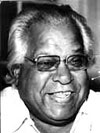
Nicolás Guillén's work is often described as an "immediate expression of Cuban life." Written usually in the language and rhythm of Cuba's poor blacks, his poems form an important part of the Afro-Antillean black poetry (poesia negra) movement.
Guillén was born in Camagüey on July 10 1902, less than 2 months after the Cuban flag was finally able to fly over Havana. He was a life-long revolutionary activist, jailed in 1936 for publishing material deemed "subversive," and released a year later. His father died in the 1917 uprising against the regime of Mario García Menocal.
In 1930 Guillén's first major work was published. Motivos de Son defined the "negrista" poetry of the French and English Caribbean by directly blaming imperialist white hypocrisy for the state of Negro life in the region. His work was considered very authentic, as most of the "Negrista" poets of the time were white, observing the Negro world from the outside. Guillén also brought to themovement a "Cuban flavor" not present in the others.
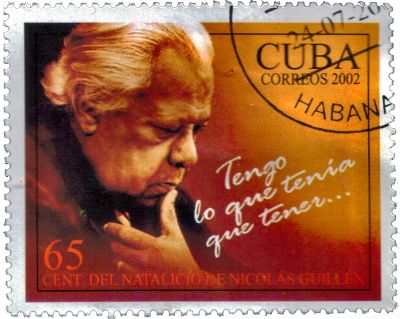
Eventually Guillén began to explore social and political themes in works such as Cantos para soldados y Sones para turistas (1937), and La paloma del vuelo popular (1958).
Guillén was exiled in 1957 by the Batista government, and he lived in Buenos Aires until 1959. He returned to Cuba after the triumph of the Revolution, and in 1961 he was officially proclaimed “Cuba’s Poeta Nacional" and later elected president of the Writers and Artists Union of Cuba.
In 1967 he published a book of poems titled El Gran Zoo, followed in 1972 by La Rueda Dentada and later El Diaro Que a Diario. His 1977 Por El Mar de Las Antillas Anda un Barco de Papel was celebrated in the Spanish language world, as was his last book in 1986; En Algún Sitio de la Privavera: Elegía.
Guillén died in Cuba on July 16, 1969.
Tengo - A Poem by Guillén in Spanish | English
Contents: Before the Revolution